
Back in 2019, I somehow came across a conference called the International Conference on Social Dilemmas. The conference seemed relevant to my research, so I decided to apply. Luckily enough, I was accepted. Armed with enthusiasm and financial support from the SSI, I packed my bags and headed to Sedona, Arizona.
One thing I remember from that first conference was an exercise involving a network. Every attendee was represented as a node, and you were asked to draw an edge to people you had collaborated with. You could also add an edge to someone you knew, even if you had never worked together. It is fair to say that I was an isolated node.
What I remember, though, is not feeling isolated. The exercise gave me the impression that this was a community with unusually strong connections between its members. People were welcoming, generous with their time, and happy to talk science. I remember Tamar Kugler making sure I was looked after, Toby Handfield discussing research with me, and Terence Daniel Dores Cruz hanging out with me in the evenings alongside other PhD students, including Giuliana, Catherine, and Simon.
Since then, I have attended four editions of the conference: Sedona, Copenhagen, Leiden, and now Shimonoseki. This year’s ICSD 2026 took place in Shimonoseki, Japan, from 1–7 June 2026.
Over the years, I have met many more people through the conference and have also invited people from my own research circles to attend. So this year, I decided to revisit that network exercise.
Using the conference programme, I constructed a dataset containing the attendees, affiliations, presentation categories, and other information. Using this dataset, I created a node for each attendee and then extracted my connected component: myself and my connections to co-authors and friends.
- By co-authors, I mean people whose names appear alongside mine on either a published paper or a working paper.
- For friends, I am only showing initials. Partly because a friendship may be more one-sided than I realise, and partly because there is a good chance I have forgotten someone. With initials, maybe I can still play the plausible deniability game.
So this is what my network looks like now:
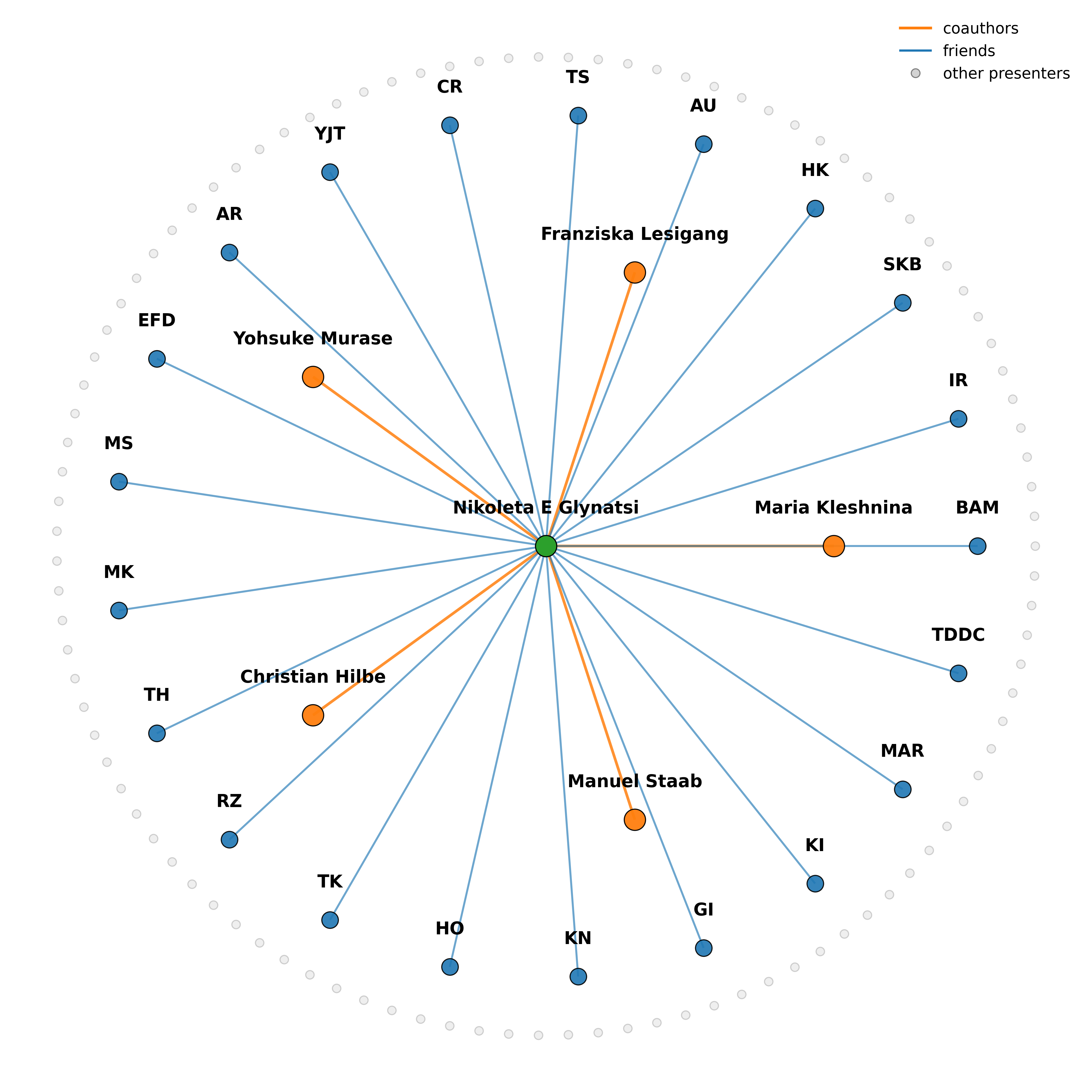
Compared to that first conference in Sedona, the difference is quite striking. That got me wondering how much the conference itself had changed over the years. Looking back, a few things stand out to me:
- The conference has grown considerably.
- There is noticeably more theoretical and computational work than when I first attended.
Of course, once I had gone through the trouble of collecting the programme data, it seemed a waste not to look at it more closely.
So, naturally, I spent some time exploring a few descriptive statistics.
This year’s conference featured 88 talks, 40 posters, 130 presenters, and 16 sessions.
The sessions covered a wide range of topics, including trust, partner choice, inequality and fairness, coordination, institutions, game theory, parochial cooperation, climate change and risk dilemmas, ingroup–outgroup dynamics, sustainability, the evolution of cooperation, conflict, applied games, reciprocity and reputation, information, and evolutionary dynamics.
The presentation titles are also interesting. Below are the most common words appearing in titles across the conference programme.
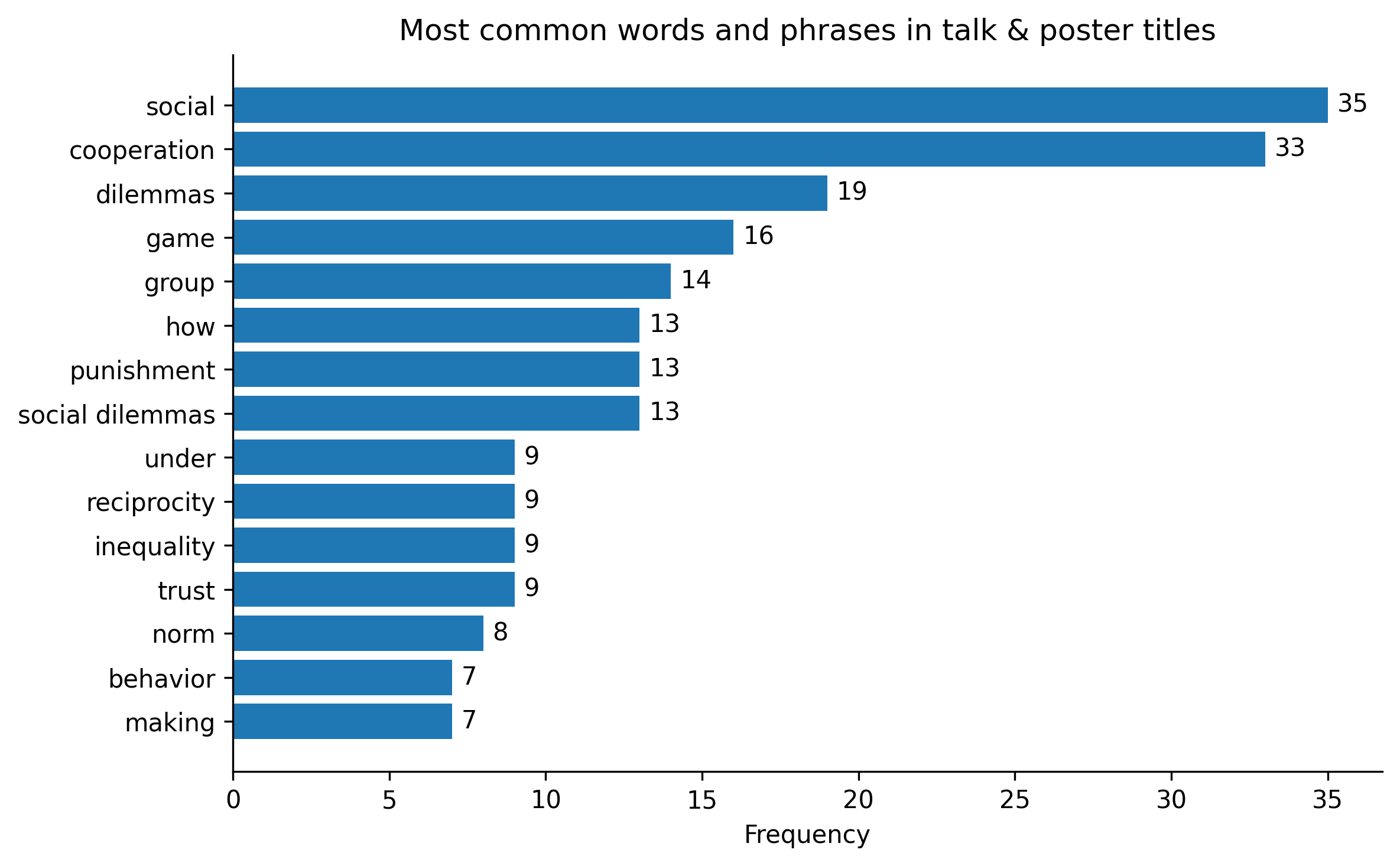
None of these words are particularly surprising. Cooperation, social dilemmas, games, trust, reciprocity, and punishment have been recurring themes throughout the history of ICSD.
The word frequencies tell us what topics appear often, but they do not tell us what a ``typical’’ ICSD presentation looks like.
To get at that question, I looked for the title that was most representative of the conference programme.
Using a TF–IDF representation of all talk and poster titles, I searched for the title that was, on average, most similar to all the other titles.
The most ICSD title at ICSD 2026 was:
The Effects of Social Network Structure and Individual Differences on Cooperation and Social Norms in Collective-Risk Social Dilemmas
Andrea Gradassi
A very deserving winner.
Finally, because I already had the titles and because this seemed like a perfectly reasonable use of my time, I used them to generate ten random ICSD-style talk titles.
To do this, I built a simple Markov model from the conference titles. The model records which words tend to follow one another and then generates new titles by randomly chaining these word pairs together:
- Social and Prosocial Behavior in the Social World
- Conflict Outcomes and Post-Agreement Moral Behavior
- Collective Welfare: Evidence from a Weighted Minority
- The Limits of Altruistic Giving
- Social Learning to Remember Less Face
- Cooperation in Coordination Games as Trust Signals
- Indirect Reciprocity-Based Cooperation: An Experimental Study
- Harmless Intent
- Environmental Framing on Networks, Inequality, or Social Behaviour
- Direct and Indirect Reciprocity: A Model of Reputational Dynamics
Great titles, right? The results were mostly nonsense, which is perhaps not surprising. One hundred and thirty titles is not enough data to train anything particularly sensible. Still, some titles are surprisingly plausible.
The programme also contains affiliation information, which makes it possible to take a quick look at the geographic distribution of the conference.
In total, affiliations from 22 countries were represented at ICSD 2026.
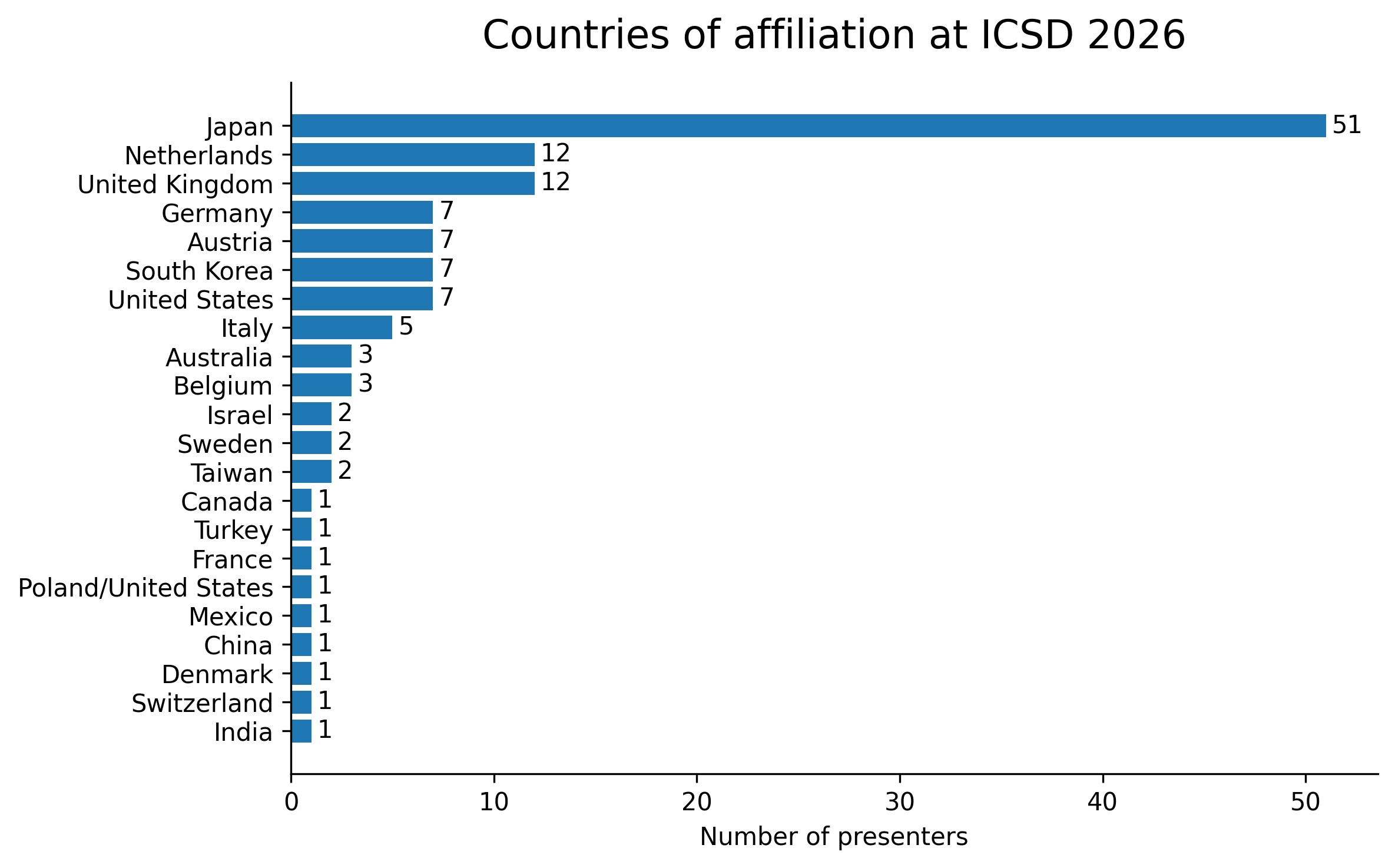
Japan, as the host country, is unsurprisingly the most represented country at the conference. There is also a strong presence from South Korea, which is perhaps less common at previous editions. I suspect this is partly due to geographic proximity and partly due to the efforts of researchers in the region to promote the conference.
A strong European presence is also apparent, particularly from the Netherlands, Germany, and the United Kingdom. Again, this is not especially surprising. ICSD has long-standing ties to research communities in the Netherlands and across Europe more broadly, and those connections continue to be reflected in the programme.
Given that the conference was held in Japan, many participants were based there. Let’s take a closer look..
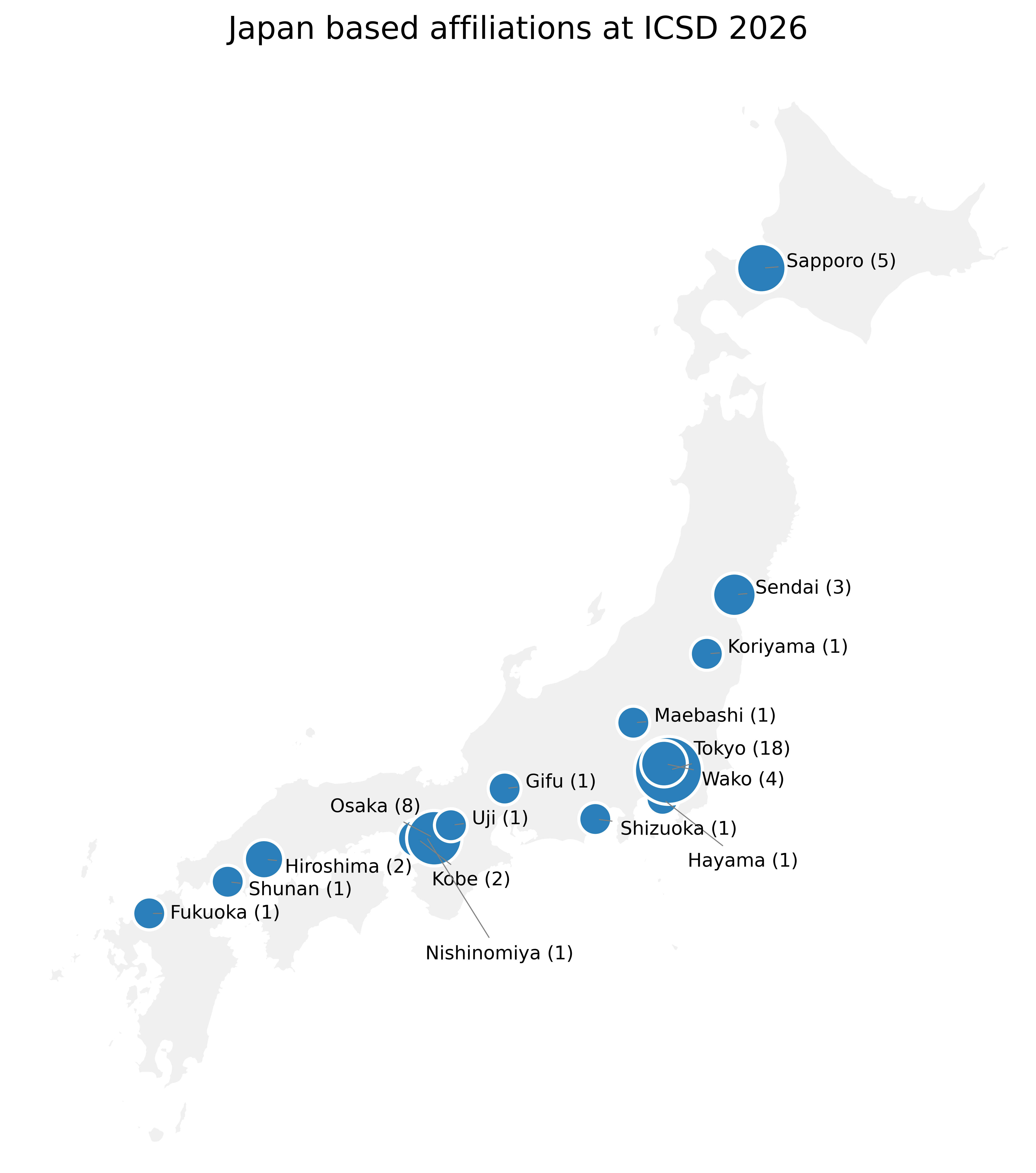
As expected, most Japanese participants were concentrated around the Tokyo metropolitan area, with smaller clusters in Kansai, Sendai, Hiroshima, Fukuoka, and Sapporo. And yes, I am the dot in Kobe, alongside my friend Yukari Jessica Tham.
The conference has been a joy, as always. Two particular highlights for me were seeing friends and watching my PhD student, Franziska Lesigang, present her work at ICSD for the first time.
Other highlights included Hisashi Ohtsuki’s keynote lecture, Tamar Kugler’s talk on leadership and if leaders are ``left behind’’, and the student presentation by Yuxin Yen, among many others.
It was also the first time that the Mathematical Social Science Team attended as a group.
Looking forward to the next installment!